Most wealth sits in one name, in one country, under one legal system. That is how people are taught to hold it, and for ordinary circumstances it is enough. It stops being enough the moment something goes wrong. A lawsuit, a creditor claim, a shift in domestic policy, a contested estate, and assets that took decades to build can be exposed in months.
An offshore trust is one of the oldest and most tested responses to that exposure. It is not a loophole and not a secret. It is a recognized, regulated legal structure that separates the ownership of assets from personal control and places them under a jurisdiction chosen for the strength of its law.
What Is an Offshore Trust?
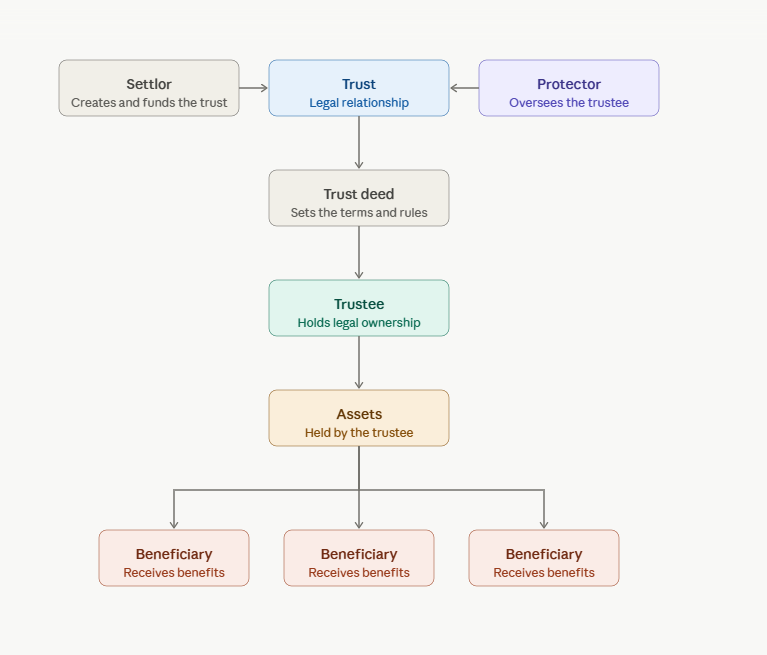
A trust is a legal relationship in which one party holds and manages assets for the benefit of another. The person who creates the trust transfers assets into it, a trustee takes legal ownership and administers those assets, and the beneficiaries are the people or purposes the trust is meant to serve. The terms are set out in a written document called the trust deed.
An offshore trust is simply a trust governed by the laws of a jurisdiction other than the one where the person creating it lives. The word “offshore” describes the choice of governing law, not a location on a map and not a degree of secrecy. People choose a foreign jurisdiction because its trust law offers protections, certainty, or flexibility that their home system does not.
The core mechanism is the separation of ownership. Once assets are properly transferred into the trust, the person who created it no longer owns them. A creditor pursuing that person is pursuing assets that are no longer theirs to take. That single legal fact is the foundation of everything an offshore trust does.
Types of Offshore Trusts
Not all trusts are built the same way. The structure is shaped by how much discretion the trustee holds and what the trust is designed to achieve.
- A discretionary trust gives the trustee the power to decide which beneficiaries receive distributions, how much, and when. No beneficiary has a fixed entitlement, which is what makes this the strongest form for asset protection. There is no defined interest for a creditor to attach.
- A non-discretionary or fixed-interest trust sets out exactly what each beneficiary is entitled to and when. It offers certainty and clarity but less protection, because a defined interest is easier for a third party to identify and pursue.
- A purpose trust exists to serve a stated purpose rather than named beneficiaries. It is often used to hold shares in a company, ring-fence an asset, or support a long-term objective that is not tied to specific individuals.
- A reserved-powers trust allows the person who created it to retain certain defined powers, such as investment decisions, while the trustee handles everything else. It appeals to those who want protection without surrendering every element of involvement, though the powers reserved must be drafted carefully so they do not undermine the structure.
Onshore vs Offshore Trusts
A domestic trust and an offshore trust rest on the same basic idea, but they behave very differently in practice.
| Feature | Onshore Trust | Offshore Trust |
| Purpose | Estate planning, probate avoidance, managing assets for family | Asset protection, succession, privacy, cross-border structuring |
| Types | Revocable and irrevocable, living and testamentary | Discretionary, fixed-interest, purpose, reserved-powers |
| Asset Protection | Limited; domestic courts can reach trust assets in many cases | Strong; leading jurisdictions do not recognize foreign judgments |
| Privacy | Often part of public probate or court records | No public register of trust details in most offshore jurisdictions |
| Estate Planning | Effective within one country’s legal system | Effective across multiple countries and legal systems |
| Tax Treatment | Taxed under the home jurisdiction’s rules | Tax-neutral in the trust jurisdiction; settlor still reports at home |
| Statute of Limitations | Long or open-ended windows for creditor claims | Short, defined windows to challenge a transfer into the trust |
| Setup and Maintenance Costs | Lower setup, but exposure costs can be high | Higher setup and annual costs, offset by stronger protection |
Key Roles in an Offshore Trust
An offshore trust works because responsibility is divided among several parties, each with a defined function. Understanding who does what is the clearest way to understand how the structure protects assets and how control is balanced.
The Settlor
The settlor is the person who creates the trust and transfers assets into it. In the United States the same role is usually called the grantor, and the two terms mean the same thing.
The settlor’s defining act is giving up legal ownership. Once assets pass into the trust, they belong to the trust, administered by the trustee. This surrender of ownership is not a loss of influence. The settlor shapes the trust through the trust deed and through a letter of wishes, a private document that guides the trustee’s discretion without binding it. What the settlor cannot do, if the structure is to hold, is retain so much control that a court could treat the trust as a sham and the assets as still personally owned. The balance between influence and control is where good drafting earns its value.
The Trustee
The trustee holds legal ownership of the trust assets and administers them according to the deed. This is a position of fiduciary duty, the highest standard of responsibility the law recognizes. The trustee must act in the interest of the beneficiaries, avoid conflicts, keep proper records, and exercise care in every decision.
In an offshore structure the trustee is normally a licensed professional trustee company based in the trust’s jurisdiction. That local presence matters. It is part of what makes the jurisdiction’s protective laws apply in full, and it places administration in the hands of a regulated party rather than an individual who could be pressured or compromised.
The Protector
The protector is an optional but widely used role, created to provide oversight. The protector does not run the trust, but holds defined powers that check the trustee, most importantly the power to remove and replace the trustee.
For many settlors the protector is the reassurance that makes the structure workable. It means handing legal ownership to a professional trustee without handing over unchecked authority. The protector can be a trusted individual, a committee, or a professional firm, and the powers are set out precisely in the deed.
The Beneficiaries
The beneficiaries are the people, or in the case of a purpose trust the objectives, the trust exists to serve. They may include the settlor’s family, future generations, the settlor themselves, or a combination.
What beneficiaries hold depends on the type of trust. Under a fixed-interest trust they have defined, enforceable entitlements. Under a discretionary trust they have no fixed right to anything, only the possibility of benefiting at the trustee’s discretion. That absence of a defined entitlement is precisely what makes the discretionary form so resistant to creditor claims. There is no fixed interest for anyone on the outside to seize.
Benefits of Setting Up a Trust Offshore
The advantages of an offshore trust all flow from the same source: assets are legally separated from the person who created the trust and placed under a legal system chosen for its strength. Here is what that separation delivers in practice.
Asset Protection
Asset protection is the reason most people first look offshore. A properly established offshore trust places assets beyond the easy reach of future creditors, litigants, and claimants.
The strength comes from the jurisdiction. Leading offshore jurisdictions do not recognize or enforce foreign court judgments against trust assets. A creditor who wins a judgment at home cannot simply present it and collect. They must bring a fresh case in the trust’s jurisdiction, in person, under local rules, often after posting a substantial bond, and within a short statutory window. Many claims never clear those hurdles. The protection is not secrecy. It is the deliberate design of the jurisdiction’s law.
Privacy
Offshore trusts are private by structure. In most leading jurisdictions there is no public register that lists the settlor, the beneficiaries, or the contents of the trust deed.
This is legitimate confidentiality, not concealment. The trust and its parties are known to the trustee, to the regulator, and to the tax authorities the settlor is obliged to report to. What changes is that the details are not available to the public, to opportunistic litigants, or to anyone running a search for assets to target.
Tax Neutrality
A well-chosen offshore jurisdiction is tax-neutral, meaning the trust itself is not subject to local income, capital gains, or inheritance tax in that jurisdiction. The structure does not add a layer of taxation on top of what the settlor and beneficiaries already owe.
Tax-neutral is not tax-free. It does not remove anyone’s obligations in their home country. The settlor and beneficiaries remain responsible for reporting and paying tax wherever they are liable. The benefit is the absence of double taxation at the trust level, not the absence of tax.
Asset Consolidation
Wealth is often scattered: property in one country, investments in another, business interests somewhere else, each under its own legal system. An offshore trust can bring those holdings under a single structure governed by one body of law.
That consolidation makes the whole estate easier to administer, easier to plan around, and easier to pass on. It replaces a patchwork of jurisdictions with one coherent framework.
Cross-Border Planning
For anyone whose life crosses borders, by family, residence, business, or citizenship, an offshore trust provides a stable legal anchor that does not shift when circumstances do.
A change of residence, a relocation, a new domestic policy at home: these can all disrupt planning built entirely within one country. A trust governed by a chosen offshore jurisdiction holds steady, giving internationally connected families a fixed point to plan around.
Estate Planning and Probate Avoidance
Assets held in a trust do not form part of the settlor’s personal estate, so they do not pass through probate. Probate is public, slow, and bound to the courts of each country where assets are held. For an international estate it can mean parallel proceedings in several jurisdictions at once.
A trust replaces that with a private, orderly transfer handled by the trustee under the terms of the deed. Beneficiaries are not left waiting on courts, and the estate is not exposed to public process.
Continuity and Control
A trust does not stop functioning when the settlor dies or becomes incapacitated. The trustee continues to administer the assets without interruption, under the same deed and the same letter of wishes.
This gives the settlor a form of reach that a will cannot match. Through the deed and the letter of wishes, they can shape how assets are managed and distributed long after they are no longer able to act themselves, with no gap and no court involvement at the moment of transition.
Multi-generational Planning
The combination of every feature above makes the offshore trust a vehicle built for the long term. It can hold and protect wealth across multiple generations, with the deed setting the rules for how each generation may benefit.
For families thinking beyond their own lifetime, including business-owning families planning succession, this is the central appeal. The trust becomes the durable structure through which a legacy is preserved, governed, and passed on, on terms the family sets rather than terms a court imposes.
How to Set Up an Offshore Trust
Establishing an offshore trust is a defined process. Done properly, with the right guidance, the core formation can move quickly once the groundwork is in place.
- Define your objectives. Be clear on what the trust is for: asset protection, succession, consolidation, or a combination. Every later decision follows from this.
- Choose a jurisdiction. Select the governing law based on the strength of its trust legislation, its treatment of foreign judgments, its statute of limitations, its regulatory reputation, and its stability.
- Appoint a trustee and provider. Engage a licensed professional trustee in the chosen jurisdiction, and decide whether the structure will also include a protector.
- Complete due diligence and KYC. Provide identity, source of funds, and source of wealth documentation. A reputable provider will insist on this. It is what keeps the structure clean and compliant.
- Draft the trust deed. Work with the provider and legal counsel to draft the deed and prepare a letter of wishes. This is where objectives become legal terms, and where careful drafting matters most.
- Transfer assets into the trust. Formally move the chosen assets into the trust’s legal ownership. Until this is properly done, the trust holds nothing and protects nothing.
- Maintain ongoing compliance. Meet annual filings, keep records current, and satisfy reporting obligations at home. A trust is a structure to be maintained, not a document to be filed and forgotten.
Reporting and Compliance
An offshore trust is a transparent, reportable structure, and that is a feature of doing it correctly, not a weakness.
Most jurisdictions, including the leading offshore ones, participate in the Common Reporting Standard, the international framework for the automatic exchange of financial account information between tax authorities. Where US persons are involved, the Foreign Account Tax Compliance Act imposes its own reporting requirements. Separately, the settlor and beneficiaries remain responsible for reporting the trust and any distributions under the tax rules of their own countries.
None of this undermines the trust. Asset protection, privacy from the public, succession planning, and tax neutrality all function fully within a structure that is properly reported. What a legitimate offshore trust does not do is hide assets from tax authorities. A structure built for concealment is not asset protection. It is a liability, and a reputable provider will not create one.
Popular Offshore Trust Jurisdictions
Offshore jurisdictions are not interchangeable. They differ in the strength of their legislation, their treatment of foreign judgments, the time limits they impose on claims, and their reputation. The five below are among the most established, each measured against those same criteria.
Nevis
Nevis is one of the strongest asset protection jurisdictions in the world. Its trust law does not recognize foreign judgments, so a creditor must bring a fresh claim on the island, in person. To do so they must first post a substantial bond, and they face a short statutory window to challenge a transfer into the trust along with a high standard of proof. The combination is deliberately demanding, and it is why Nevis has a long track record as a protective jurisdiction.
Cook Islands
The Cook Islands is the other globally recognized leader in asset protection and the jurisdiction credited with pioneering the modern protective trust statute. Like Nevis, it declines to recognize foreign judgments, sets a high evidentiary bar for challengers, and imposes tight limitation periods. Its case law in this area is among the most developed anywhere, though its distance and cost are practical considerations.
Cayman Islands
Cayman is a premier international financial center, best known for the depth of its financial services industry and its standing among institutions and professional advisors. Its trust law is sophisticated and well regarded. Its focus leans more toward wealth structuring, investment, and estate planning than toward the aggressive creditor-facing protection that defines Nevis and the Cook Islands.
Belize
Belize offers strong protective trust legislation with quick formation and competitive costs. Its statute provides for immediate protection on settlement in defined circumstances and limits the reach of foreign claims. It is frequently considered alongside Nevis as a cost-effective protective jurisdiction, though its track record is shorter than that of the longest-established names.
Liechtenstein
Liechtenstein is a long-established European jurisdiction with a civil-law tradition and decades of experience in wealth structuring, trusts, and foundations. It offers stability, a strong regulatory framework, and access to the European economic area. It is generally chosen for legacy planning, family governance, and structuring continuity rather than for frontline creditor protection.
Jersey
Jersey is a leading Channel Islands jurisdiction with a trust law rooted in English principles and a blue-chip international reputation. It is heavily used for estate planning and the structuring of substantial family wealth, and it is well regulated and widely respected. As with Cayman and Liechtenstein, its strength is in prestige and planning rather than in the hard creditor-facing protection of the specialist jurisdictions.
Why Nevis Is Our Preferred Jurisdiction
Measured against every criterion that matters for asset protection, Nevis stands out. It pairs genuinely formidable protective law with efficient formation, a stable English common law foundation, and a track record reaching back decades.
The Nevis International Exempt Trust Ordinance
The strength of a Nevis trust rests on its governing statute, the Nevis International Exempt Trust Ordinance. The Ordinance does the protective work that makes the jurisdiction effective.
It establishes that foreign judgments are not recognized against a Nevis trust, so a creditor cannot import a win from another country. It requires a creditor to bring any claim in Nevis itself and to post a substantial bond before doing so. It sets a short limitation period for challenging a transfer into the trust and holds the challenger to a high standard of proof. It confirms that a settlor may also be a beneficiary without weakening the structure, and that retaining certain defined powers does not invalidate the trust. Taken together, these provisions are not incidental protections. They are the deliberate design of a jurisdiction built for this purpose.
Work With Trust Nevis
Trust Nevis is a modern professional service provider built on Nevis law and real-world structuring experience. We work with individuals, families, and entrepreneurs to protect assets, preserve privacy, and plan succession using Nevis trusts and related structures.
Our work is grounded in local law and legal precedent, handled with precision rather than a sales pitch, and built to last. Trusts can often be formed within 48 hours once documentation is in order, and we provide ongoing trustee, protector, and compliance services so the structure is maintained properly over its full life.
To discuss whether a Nevis trust fits your circumstances, schedule a free consultation with our team.
Frequently Asked Questions
Is an offshore trust legal?
Yes. An offshore trust is a recognized, lawful legal structure. What matters is how it is used. A trust established for asset protection, succession, and privacy, and properly reported to the relevant tax authorities, is entirely legal. A structure built to hide assets or evade tax is not, and a reputable provider will not create one.
Are offshore trusts only for the ultra-wealthy?
No. Offshore trusts are used by business owners, professionals in litigation-exposed fields, internationally mobile families, and others who have meaningful assets to protect, not only the very rich. There is a real cost to setting one up and maintaining it, so it suits people with assets substantial enough to justify that cost, but that is a far wider group than the ultra-wealthy alone.
Do you need a lawyer to set up an offshore trust?
You do not strictly need to instruct your own separate lawyer, because a licensed trust provider handles the drafting and formation. But the structure should always be set up with qualified professional guidance, and many clients involve their own legal and tax advisors alongside the provider, particularly where the structure interacts with their home-country position.
How much does it cost to set up an offshore trust?
Costs vary by jurisdiction, by the provider, and by the complexity of the structure and the assets involved. There is a setup fee and an ongoing annual cost covering trustee and administration services. The right way to assess cost is against the value of the assets being protected and the exposure being addressed, not in isolation. A provider can give a clear quote once the intended structure is known.
Can I be a beneficiary of my own offshore trust?
Yes, in the right jurisdiction. Nevis law, for example, expressly allows the settlor to also be a beneficiary without weakening the trust. This must be structured correctly, because retaining too much direct control is a separate issue, but being a beneficiary of your own trust is permitted and common.
Can creditors break an offshore trust?
It is very difficult in a strong jurisdiction. A creditor generally cannot enforce a foreign judgment and must bring a fresh claim in the trust’s jurisdiction, in person, often after posting a bond, within a short limitation period, and to a high standard of proof. Those barriers defeat many claims. No structure is absolutely guaranteed, and a trust set up to defraud an existing, known creditor can be challenged, which is why timing and proper establishment matter.
Do I still pay tax if I have an offshore trust?
Yes. An offshore trust does not remove your tax obligations. The trust jurisdiction may be tax-neutral, meaning no tax at the trust level, but you and the beneficiaries remain liable for tax and reporting under the rules of your own countries. An offshore trust is a tool for protection and planning, not for avoiding tax you owe.
What is the difference between an offshore trust and an offshore foundation?
A trust is a legal relationship: a settlor transfers assets to a trustee, who holds them for beneficiaries. A foundation is a separate legal entity in its own right, with no owners or shareholders, that holds assets to serve a defined purpose or class of beneficiaries. A trust rests on common law and the fiduciary duty of the trustee; a foundation has its own legal personality and is governed by its charter. Both can protect assets and plan succession, and the better fit depends on the client’s background, goals, and home jurisdiction.